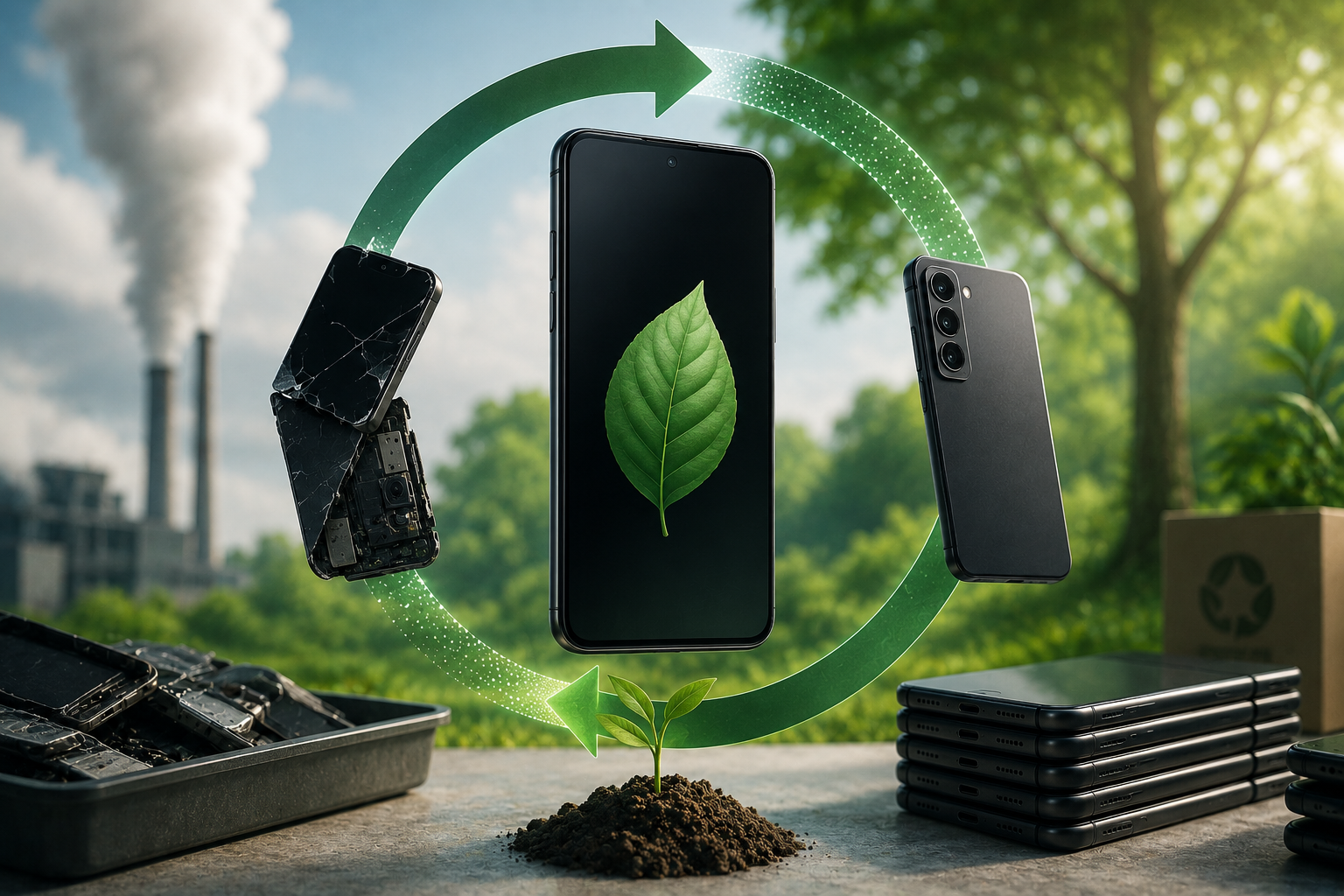
Extending Smartphone Lifecycles to Cut CO2 Emissions
The global push for corporate sustainability has placed IT asset disposition squarely in the spotlight. Modern environmental, social, and governance initiatives require companies to scrutinize the hidden ecological costs of their technology fleets. The fastest way to reduce your corporate technological footprint is by extending the active lifespan of your hardware.
Replacing corporate devices annually creates a massive, unsustainable burden on the global climate. By partnering with experts like CellDe, organizations can deploy software that accurately diagnoses and rescues older hardware from premature destruction. This proactive approach to Lifecycle extension transforms reverse logistics into a powerful tool for achieving strict corporate sustainability targets.
The Carbon Reality of Mobile Device Manufacturing
Understanding the carbon footprint of manufacturing a new smartphone
To truly understand the environmental impact of corporate technology, ESG officers must look at the entire supply chain. Most of the device's carbon footprint is not generated by the electricity used to charge it nightly. It is generated by the incredibly energy intensive industrial processes required to build it in the first place.
Why 80 percent of a device carbon impact occurs before its first use?
It surprises many sustainability officers to learn that the daily use of a mobile phone represents a tiny fraction of its total emissions. The fabrication of internal integrated circuits and microprocessors requires highly specialized, energy hungry fabrication plants. These facilities operate constantly, contributing heavily to global greenhouse gas output.
Because the manufacturing phase is so carbon intensive, roughly four fifths of the total atmospheric damage is done before the phone is unboxed. Once the device leaves the factory, its ongoing energy consumption is mathematically negligible by comparison. This fundamental imbalance means that recycling a phone after only one year is incredibly wasteful.
You cannot recycle your way out of this initial manufacturing carbon debt. The energy required to shred and melt down a perfectly functional one year old phone is just another drain on the environment. The only logical way to offset that massive initial carbon spike is through dedicated Lifecycle extension.
The environmental burden of mining rare earth metals for electronics
Smartphones rely on a complex recipe of rare elements like cobalt, lithium, and neodymium to function properly. Extracting these materials from the earth is an incredibly destructive and toxic process.
Mining operations require massive diesel-powered excavators and incredibly toxic chemical refinement baths. These processes strip away natural habitats and release vast amounts of trapped carbon dioxide directly into the atmosphere. Every new phone ordered by a corporation directly funds and accelerates this ecological destruction.
Ecological Cost of New Versus Refurbished Hardware
Ecological Metric | New Device Manufacturing | Refurbished Device Processing |
Raw Material Needs | Requires extensive fresh mining | Utilizes existing refined materials |
Energy Consumption | Highly intensive factory production | Low impact software diagnostics |
Water Usage | Massive volumes for chemical refinement | Negligible water footprint |
Waste Generation | Creates toxic mining tailings | Prevents electronic landfill waste |
The Mathematics of Lifecycle Extension
How adding one year to a device lifespan reduces its CO2 impact
The mathematics of hardware sustainability is incredibly straightforward and highly impactful for ESG reporting. If a phone carries a massive initial manufacturing footprint, you must divide that footprint by the number of years it remains active. A device replaced every twelve months carries double the annual carbon burden of a device kept for twenty-four months.
Simply delaying a corporate hardware refresh cycle by a single year dilutes the annual emissions penalty, optimizing the asset's utility before retirement. It effectively cuts the hardware carbon footprint of your IT department in half without requiring complex operational overhauls. This is the most efficient way to Cut CO2 emissions smartphones within a corporate environment.
Calculating the total emissions saved by the global refurbished market
The secondary smartphone market is a massive, decentralized engine for global climate action. Every time a consumer or business chooses a refurbished device over a new one, a manufacturing cycle is completely avoided. This collective action prevents millions of tons of carbon dioxide from entering the atmosphere annually.
By utilizing advanced tools from CellDe, businesses fuel this green economy by ensuring their retired devices are perfectly sanitized and ready for resale. A healthy secondary market requires a steady stream of high quality, data-wiped corporate hardware. When your company participates efficiently, you contribute directly to global emission reduction targets.
The Environmental Protection Agency emphasizes that repurposing electronics conserves vital natural resources and drastically reduces pollution. Participating in the circular economy is no longer just a financial strategy; it is a critical environmental mandate.
The compounding environmental benefits of multiple device owners
A flagship smartphone is engineered to last far longer than the standard two-year corporate contract. When an enterprise retires a corporate fleet, deploying CellDe Smart Trade-In enables these devices to safely enter the secondary market by automating the intake, multi-device valuation, and chain-of-custody logging.
This cascading ownership model operationalizes circular economic theory, spreading the initial carbon debt across multiple consecutive users. The massive initial carbon cost of the factory is spread across three or four different end users over half a decade. This maximizes the utility of the mined rare earth metals and justifies the original industrial energy expenditure.
Operational Strategies for Extending Device Utility
Utilizing automated diagnostics to identify repairable devices quickly
To keep devices in circulation longer, warehouse teams must be able to accurately identify hardware issues. Manual testing is slow, highly subjective, and often results in perfectly fixable phones being sent to the shredder. This destroys the potential for Lifecycle extension and generates unnecessary toxic landfill waste.
Integrating CellDe Smart Diagnostics eliminates visual guesswork and manual diagnostic errors from warehouse floors. Automated algorithmic testing queries the internal hardware logic directly to pinpoint a failing battery cell or an unmapped sensor array in under two minutes, preserving units that would otherwise be rejected. This allows technicians to route the device for a quick component swap rather than total destructive recycling.
Streamlining the refurbishment pipeline to keep devices in circulation
A sustainable reverse logistics pipeline must be incredibly fast and highly organized. Devices sitting idle in a warehouse for months are losing their technological relevance and market value. If an older phone becomes too obsolete to sell, it will inevitably end up as toxic electronic waste.
To prevent this, facility managers must utilize software that connects diagnostics directly to their inventory routing systems. To establish an efficient pipeline, internal hardware checks must be coupled with standardized cosmetic evaluation.
By implementing CellDe Vision Grade's guided 6-angle photo workflow, facilities leverage machine-learning defect detection to instantly lock in a verified CTIA cosmetic grade. This automated standard ensures the device can be accurately priced and listed on secondary wholesale channels without processing delays.
Tracking and reporting carbon offsets for corporate ESG initiatives
Modern corporate boards require hard, verifiable data to prove the success of their environmental programs. Vague promises about recycling are no longer sufficient for strict global regulatory bodies. You must be able to mathematically prove exactly how your IT asset disposition strategy actively reduces emissions.
These tangible, reportable metrics elevate your IT department from a cost center to a massive driver of corporate goodwill. Utilizing centralized cloud dashboards within CellDe Smart Reports ensures that your environmental tracking efforts are audit-ready, standardized, and transparent for executive stakeholders and regulatory reporting.
Integrating ESG Goals with ITAD Workflows
ESG Objective | Traditional ITAD Barrier | Software Driven Solution |
Reduce E Waste | Blanket shredding of older hardware | Algorithmic triage saves repairable units |
Lower Carbon Footprint | Frequent, unnecessary hardware upgrades | Diagnostic data proves older hardware is still viable |
Transparent Reporting | Lack of visibility into final asset disposition | Cloud dashboards track every repurposed device |
Promote Circularity | Slow processing causes market obsolescence | Automated workflows speed up secondary market entry |
Aligning Technology with Global Climate Goals
The fight against global climate change requires massive structural shifts in how we consume commercial electronics. The era of disposable corporate hardware is definitively over. Organizations can no longer ignore the severe ecological damage caused by continuous, aggressive hardware refresh cycles.
Do not let inefficient reverse logistics sabotage your corporate sustainability mandates. Empower your processing facilities with the industry leading diagnostic and erasure tools required to drive real environmental change. Secure your data, protect the planet, and contact us today to build a truly sustainable device lifecycle program.
