Scaling Wholesale Operations: Managing 200+ Device Wipes per Technician Shift
The IT Asset Disposition industry is evolving at a breakneck pace. Facilities are overwhelmed by the massive volume of retired corporate smartphones entering the secondary market. To survive and remain profitable, warehouse managers must find innovative ways to Scale wholesale mobile wipes. Relying on outdated manual processes destroys operational profit margins.
By partnering with industry leaders like CellDe, facilities can completely transform their warehouse processing floors. We help managers empower individual technicians to process hundreds of devices daily without sacrificing security. This optimization improves your Wiping throughput and directly attacks your largest operational expenses.
The Challenge of Scaling ITAD Throughput
Sequential wiping is the most significant bottleneck in traditional reverse logistics. A technician plugs in a single smartphone, initiates the software, and waits for the process to complete. This one-by-one approach is entirely unsustainable for modern high volume warehouse operations. It places an artificial ceiling on your facility's output.
When employees are forced to monitor individual screens, your overall Wiping throughput collapses. You cannot process bulk shipments if your pipeline only moves on a single device at a time. To remain competitive, warehouses must abandon sequential processing entirely.
The exponential growth of ITAD labor costs
Labor remains the single highest expense in any processing facility. When technicians stand idle waiting for software to finish, you are actively losing money. This daily operational inefficiency causes a massive spike in your overall ITAD labor cost.
As operational demand increases, businesses need scalable workflows that improve efficiency without proportionally increasing labor costs. Automated systems and streamlined processes help organizations handle higher processing volumes more effectively while maintaining productivity, consistency, and profitability.
Why does managing high volume intake require a new processing model?
Wholesale buyers consistently demand massive quantities of fully sanitized devices on strict deadlines. If your warehouse cannot meet these bulk orders quickly, buyers will shift to your competitors. You cannot solve a volume problem by simply hiring more technicians.
Adding more bodies to an inefficient process only creates warehouse floor congestion. You must fundamentally change the technological architecture of how the work is actually performed. This requires shifting from human-driven workflows to software-driven automation.
Moving to Parallel Processing Architecture
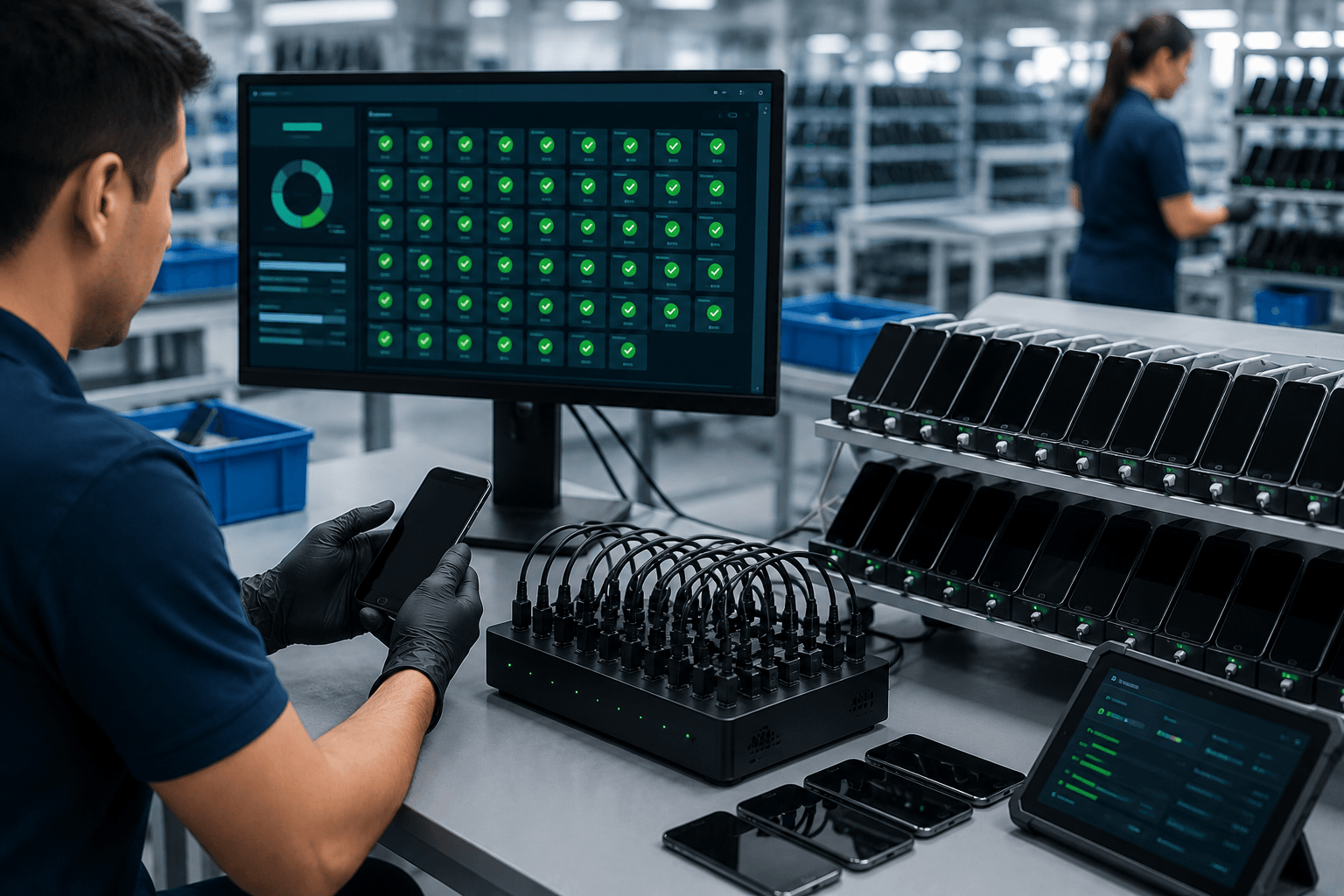
The foundation of modern warehouse scaling is the industrial USB diagnostic hub. These specialized hardware racks allow a single computer terminal to connect to dozens of smartphones simultaneously. This creates a highly dense, hyper-efficient workstation for your technicians.
Instead of walking between multiple disjointed desks, the technician operates from a centralized command post. This reduces physical fatigue and accelerates the physical connection process. Industrial hubs provide stable power and data connections crucial for enterprise software.
Sequential Processing Versus Parallel Architecture
Operational Metric | Sequential Wiping Method | Parallel Processing Architecture |
Technician Workflow | Reactive and constantly interrupted | Proactive and highly continuous |
Space Utilization | Requires massive linear desk space | Highly condensed vertical rack systems |
Bottleneck Risk | High risk of single device failures | Isolated failures do not stop the batch |
Scalability | Severely limited by human speed | Limited only by local hardware ports |
Connecting and processing dozens of devices simultaneously
Parallel processing software is the engine that drives high volume facility output. By utilizing advanced enterprise platforms like Smart Wipe, technicians can launch simultaneous data destruction commands. The software manages bandwidth and processing power across all connected USB ports automatically.
This enables teams to process and securely sanitize multiple devices simultaneously, improving operational efficiency and reducing manual workload. Enterprise-grade software also helps maintain consistent data sanitization practices across all connected devices, supporting security, compliance, and standardized workflow management.
How does software automation reduce technician cognitive load?
Managing dozens of devices at once sounds overwhelming, but automation makes it simple. Advanced software utilizes clear visual indicators, like color coded progress bars, on a central dashboard. The technician does not need to read complex error logs or system files.
If a device fails to wipe, the software highlights the specific port in red instantly. This reduces the cognitive load on your warehouse workforce. They only need to interact with the system when the software specifically prompts them for an action.
Maximizing Technician Efficiency
Hitting the benchmark of 200 plus device wipes per shift
Achieving over two hundred wipes per technician shift requires absolute workflow discipline. The technician continuously cycles through the connection hubs, removing finished devices, and plugging in new ones. This creates a perpetual motion system where the software is never idle.
While batch A is actively wiping, the technician is physically connecting batch B. This continuous integration methodology maximizes every single minute of the working shift. It transforms a standard warehouse worker into a highly leveraged machine operator.
Consolidating diagnostics and data erasure into a single step
Efficiency peaks when you remove redundant touches from the warehouse floor. Moving a phone from a diagnostic station to a separate wiping station wastes incredible amounts of time. Enterprise software combines these two critical steps into one seamless digital workflow.
The moment the phone is plugged in, the system checks the hardware and wipes the data sequentially. This single touch methodology is critical for lowering your ITAD labor cost. The less your team physically handles the device, the faster it reaches the wholesale buyer.
Tracking individual technician performance through analytics
To continuously scale wholesale mobile wipes, management needs crystal-clear operational data. By leveraging central cloud-based dashboards within CellDe Smart Reports, enterprise facilities gain complete visibility into floor operations. This module tracks the exact processing output of every active workstation, allowing management to monitor precisely how many devices each individual technician completely sanitizes and grades per hour to optimize labor allocation.
This data allows managers to identify training gaps or failing hardware ports instantly. The Environmental Protection Agency stresses that efficient processing is key to managing the growing global e-waste volume safely. Analytics ensure your facility operates at peak environmental and financial efficiency.
Leveraging Analytics for Workforce Optimization
Management Focus | Traditional Blind Spots | Analytics Driven Insights |
Performance Tracking | Guessing daily output per worker | Real time visibility of exact shift metrics |
Process Bottlenecks | Unknown causes of processing delays | Instant alerts for failing USB hubs |
Quality Control | Discovering wipe failures at shipping | Catching failed sectors during active processing |
Resource Allocation | Overstaffing slow processing days | Precision scheduling based on intake volume |
Future Proofing Your ITAD Facility for Global Growth
The secondary mobile market will continue to expand aggressively over the next decade. Facilities that rely on manual workflows will simply collapse under the weight of incoming inventory. Optimizing your warehouse workforce is the absolute key to long term corporate survival.
By implementing parallel processing, you empower your team to do more with significantly less effort. You increase your Wiping throughput while driving down overhead costs. This operational agility allows you to accept massive wholesale contracts that your competitors cannot handle.
Do not let outdated software limit your facility's output. Upgrade your processing floors with the most powerful automation tools in the industry. Contact us today to schedule a demonstration and permanently optimize your reverse logistics pipeline.
